

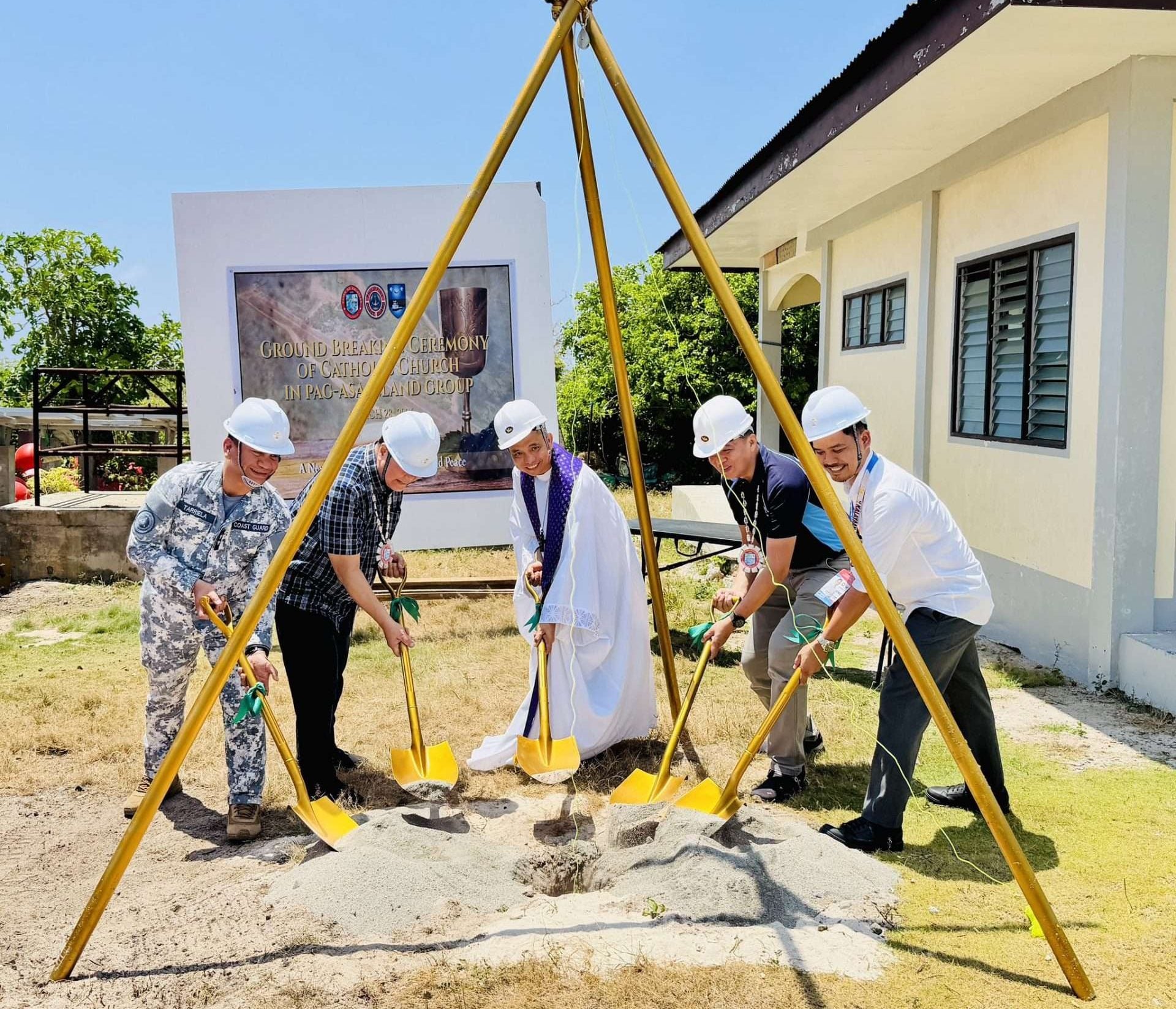
Bishop Socrates Mesiona joins the groundbreaking of the first Catholic chapel on Pag-asa Island
Courtesy of Rear Admiral Jay Tarriela
Pag-asa is the only inhabited island in the Kalayaan Island Group, which includes islands and two reefs occupied by the Philippines. Mobile networks have only recently reached the island.
Work began on a Catholic chapel on a remote Philippine island claimed by China, boosting the Filipino presence in the geopolitical hot spot.
The local Catholic Church and the Philippine Coast Guard presided over the ground-breaking of the chapel on Pag-asa Island in Kalayaan, Palawan province, on 28 March. It will be the island’s first permanent Catholic structure, nearly five decades after the late dictator Ferdinand E. Marcos formally included Pag-asa in the country’s territory.
Pag-asa, which is the Filipino word for “hope”, is a 32.7-hectare island located 932 kilometres (580 miles) from the capital Manila. It is situated in the West Philippine Sea, a resource-rich body of water contested by China – the thorniest aspect of ties between Manila and Beijing, despite a 2016 international ruling that invalidated Chinese claims.
Around 400 civilians, mostly fisherfolk, live on Pag-asa. It is the only inhabited island in the Kalayaan Island Group, which includes islands and two reefs occupied by the Philippines. Mobile networks have only recently reached the island and teachers have been flown in by the government to provide schooling.
“The primary objective of constructing this Roman Catholic church on Pag-asa Island is to fulfil and nurture the spiritual needs of our local residents, providing a sacred space where faith can flourish amid the threatening Chinese presence in the West Philippine Sea,” said Rear Admiral Jay Tarriela, spokesperson of the Philippine Coast Guard.
“Far more than a mere physical structure or architectural edifice, this church stands as a powerful symbol of hope, resilience and unity,” Tarriela added.
Bishop Socrates Mesiona, the apostolic vicar of Puerto Princesa in Palawan, said he views the chapel as a symbol of faith from which residents can draw strength in times of trials.
Mesiona also expressed hopes that the chapel will strengthen the residents’ sense of ownership of Pag-asa Island. “It is saddening when a Filipino says this is not ours,” said the local bishop. “May this be a sign of unity.”
Other Filipino bishops have also made efforts to defend the country’s maritime claims. In July 2024, the Archbishop of Lingayen-Dagupan Socrates Villegas led a fluvial procession in another part of the West Philippine Sea, stating that peace can only come “from the heart of God and the hand of the Immaculate Mother”.
Philippines court brands ‘solidarity as terrorism’ say churches after convictions
Filipino voters urged to remember cardinals’ oath at election
