

Energy supplies will need time to restart despite Iran and the US finally striking a peace deal
Published Tue, Jun 16, 2026 · 11:27 AM
[MANILA] Oil’s much-awaited decline may offer little respite for hard-hit consumers in the Philippines, where local pump prices were quick to skyrocket but could take up to a year to normalise.
Energy supplies will need time to restart despite Iran and the US finally striking a peace deal. In the Philippines, which sources nearly all of its oil from the Middle East, fuel prices likely will not return to pre-war levels for another six to 12 months, the government has warned.
While consumers from Singapore to Indonesia are feeling the sting of the global oil crisis, Filipino households are by far the most vulnerable, as they contend with the region’s hottest inflation and barely any government subsidy to defray their costs.
That risks hollowing out the core of the Philippines’ economic growth story: its young population which dominates the nation’s 113 million people and their appetite to spend. Household spending, which accounts for a whopping 80 per cent of national output, expanded at its slowest pace in 16 years outside the pandemic last quarter, the weakest across South-east Asia.
The Asean+3 Macroeconomic Research Office cut its outlook for Philippine economic growth this year to 4.1 per cent from an initial 5.3 per cent, the biggest downgrade across the region.
The International Monetary Fund also slashed its forecast in April to 4.1 per cent from 5.6 per cent. Both are still some way away from the 2.8 per cent print reported in the first quarter.
“Persistent commodity price pressures are likely to weigh more heavily on domestic demand and economic growth than in other regional economies that are less reliant on imported energy,” said Moody’s Analytics economist Sarah Tan, who expects Philippine consumption to stay soft through the rest of the year.
The malaise is evident from the streets to the supermarkets in what was once the fastest-growing economy in South-east Asia.
Motorcycle taxi driver Rico Baylon, 46, is cutting back on spending after higher petrol prices reduced his daily income by a third to just 2,000 pesos (S$43). He’s resorted to switching off his vehicle’s engine during traffic jams and telling his five children to stay home to avoid spending on commutes and dining out.
SEE ALSO


The government’s one-time cash aid of 5,000 pesos for transport workers lasted just a few days to cover his kids’ needs, Baylon said. “I wish the government would do more to lower gas prices – maybe remove the tax because that will help us a lot,” he said.
Consumer confidence was weak even before the onset of the Iran war. A massive corruption scandal last year paralysed both private and government spending.
Inflation has eroded purchasing power, with one peso in 2018 now equivalent to only 0.73 peso, the latest data from the statistics agency showed.
The Middle East conflict has only added to the strain, curtailing the flow of money from millions of Filipinos working overseas that have long become a lifeblood for their families here. The latest jobs report showed more workers are looking for extra hours or jobs.
“Many families may have decided to put aside a larger proportion of their incomes in case there are layoffs,” said HSBC Holdings economist Aris Dacanay. “However, due to the higher cost of living as a result of the energy shock, there is a risk of households, especially low-income households, dipping into the savings they have accumulated just to make ends meet.”
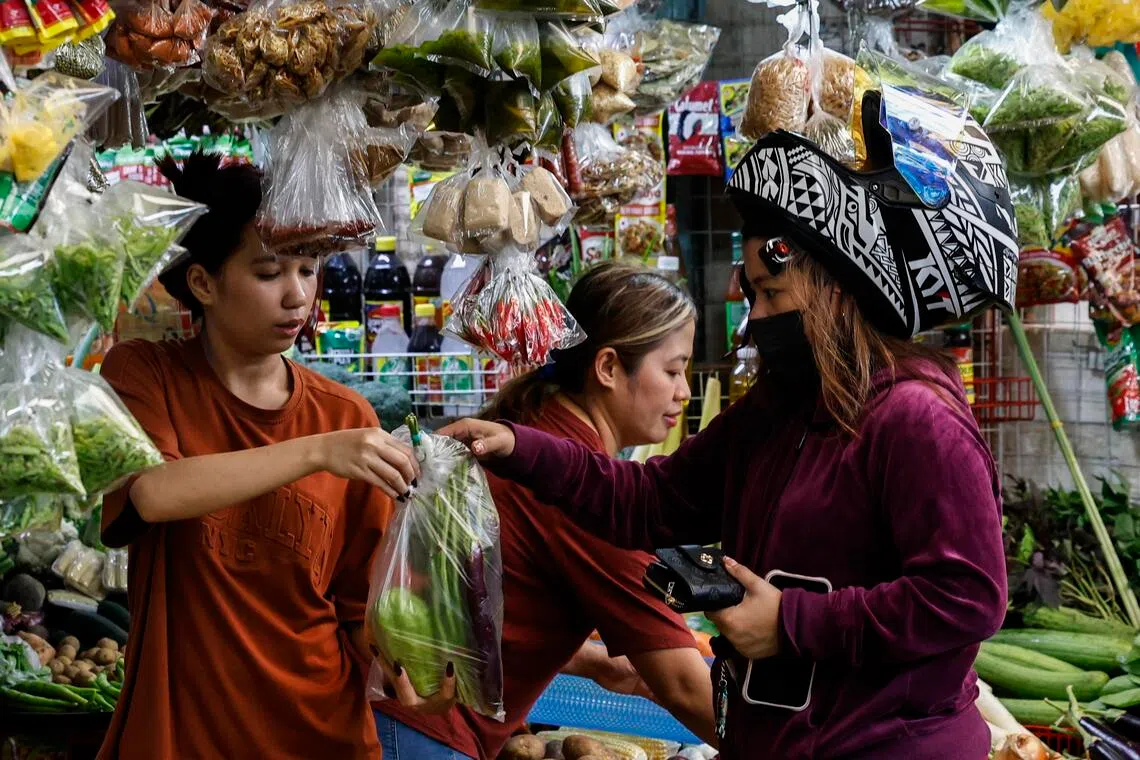
Supermarkets across the country are already seeing changes in consumer patterns. Buyers are opting for cheaper brands or items in smaller packages to stretch their resources, according to Steven Cua, president of the Philippine Amalgamated Supermarkets Association.
“Consumers still buy peanut butter, but instead of buying Skippy, they buy the cheaper one or the one in a sachet, just to have something on their breads for now,” Cua said.
That’s prompted companies to tighten their belts too, according to Perry Ferrer, who leads the nation’s largest business organisation. “They are all very cautious now,” he said.
Top fast-food chain Jollibee Foods suffered a 39 per cent profit drop last quarter due to higher commodity and supply-chain expenses, prompting a review of its expansion plans.
Property developer Ayala Land has reduced its capital expenditure budget by about a third while rival SM Prime Holdings is reviewing its own spending plan.
To help consumers, the government is considering a supplemental budget while a Senate ad hoc committee is pushing for another 7.5 billion pesos in monthly aid for minimum-wage earners, more than doubling the 3.5 billion pesos in targeted subsidies so far deployed for transport workers.
However, that would further bloat the budget deficit. The nation’s debt-to-gross domestic product ratio is already at the highest in over two decades and exceeds the internationally accepted 60 per cent threshold.
Ratings agencies are keeping watch. “If the economic situation remains weak, the government could be compelled to absorb a higher deficit with a supplementary budget to support the economy,” S&P Global Ratings director Andrew Wood said.
A much slower economic expansion will require the government to recalibrate its forecasts for spending, borrowing and revenue generation, the Congressional Policy and Budget Research Department of the Philippines’ House of Representatives said in a report in May.
“The prevailing strategy of outgrowing its debt obligations has now been made wholly untenable,” the think tank warned. “Maintaining pre-crisis levels of debt and deficit spending runs the risk of aggravating the current energy and cost-of-living crises with a debt crisis.” BLOOMBERG
