

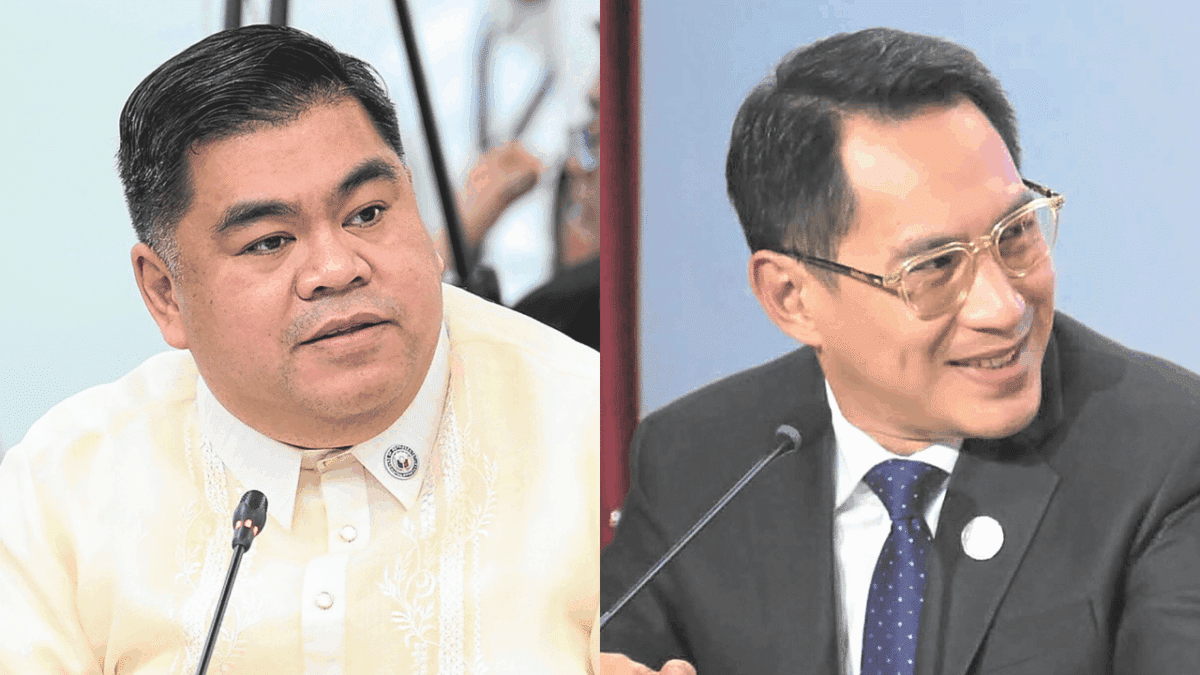
MANILA, Philippines — Lanao del Sur Rep. Zia Alonto Adiong and Tingog party-list Rep. Jude Acidre on Friday said it comes as no surprise that a large majority of Filipinos want Vice President Sara Duterte to personally appear at a Senate impeachment trial, saying the public clamor reflects the weight of the evidence already presented in the articles of impeachment and during the House clarificatory hearings.
Their reaction came after a Tangere survey released Wednesday found that 90 percent of respondents want Duterte to appear before the Senate, while 82 percent said she should personally attend the proceedings instead of relying solely on legal representation. Only 8 percent believed the appearance of her lawyers would suffice, while 7 percent said she should not face the Senate at all.
The Tangere survey showed that support for Duterte’s personal appearance cut across political affiliations. Among respondents aligned with the Marcos administration, 94 percent favored her attendance, followed by 92 percent of Liberal Party supporters, 90 percent of unaffiliated respondents, and 70 percent of Duterte’s own supporters.
READ: Sara Duterte on impeachment: Many congressmen use my name for money
For Adiong, the results merely reflect what the public has already seen in the House proceedings.
“It is not surprising that nearly nine out of 10 Filipinos want Vice President Sara to face the Senate trial. Given the weight of the evidence, the people are not looking for a lawyer. They want Vice President Sara herself,” Adiong said.
He added that once the public sees the charges in full, the demand for her personal appearance becomes understandable.
“If there are questions about the P612.5 million in confidential funds, the P6.77 billion money trail, the cash envelopes at the Department of Education, and threats that escalated to an alleged assassination plot, it is only natural that the public wants her to face them,” he said.
For his part, Acidre said the survey simply confirmed what emerged once the hearings exposed the full picture.
“The survey results are not surprising. After the hearings, people saw that this is not just about a single issue. Article I alone is already serious, especially when you add the unexplained wealth, bribery, and grave threats,” Acidre said.
READ: Ortega to Duterte on solons’ ‘money-making’ claim: Don’t play victim
The lawmaker said Article II, in particular, helps explain why even people outside Duterte’s critics now want her to personally answer the allegations.
“If Article II alone already raises questions about the (Statement of Assets, Liabilities and Net Worth or) SALN and billions of pesos in money movements, why should only lawyers explain? Of course, the public wants her herself to answer,” he said.
Adiong said the public has already moved beyond procedural arguments and now wants direct accountability.
“Press conferences, technicalities, and proxy defenses are no longer enough. When the issue involves articles of impeachment, the public expects personal answers,” he said.
Acidre echoed the same point.
“When articles of impeachment involve confidential funds, cash inducements, ill-gotten wealth, and threats against the president, a proxy appearance cannot serve as a defense,” he said.
With the plenary having referred the justice committee report to the committee on rules, and lawmakers given copies and time to review the articles and supporting evidence ahead of the May 11 vote, both lawmakers said the Tangere results point to one conclusion.
“When you actually study Articles I to IV of the impeachment, and you follow the clarificatory hearings, it becomes clearer that Vice President Sara needs to appear and answer directly. No amount of embellishment in her press releases or drama in her lawyers’ press conferences can replace that. That is the public sentiment: Vice President Duterte herself should appear and answer in the proper forum,” Adiong said.
READ: 215 lawmakers back 2026 Duterte impeachment, matching 2025 tally – Ridon
There are four articles of impeachment contained in the House justice committee report.
Article I alleges the systematic misuse, misappropriation, and irregular liquidation of P612.5 million in confidential funds under the Office of the Vice President and the Department of Education. It cites the disbursement of P125 million in late 2022, the use of unauthorized intermediaries, Commission on Audit disallowances, National Bureau of Investigation handwriting findings on acknowledgment receipts, and Philippine Statistics Authority verification issues involving names listed in those receipts.
Article II centers on alleged unexplained wealth, including the increase in Duterte’s declared net worth from P7,250,497 in 2007 to P88,512,370.22 in 2024, against estimated lawful income of around P30 million, as well as the P6,771,227,712.95 in covered and suspicious transactions reflected in Anti-Money Laundering Council records involving Duterte and her spouse.
Article III accuses Duterte of bribery, graft and corruption, culpable violation of the Constitution, and betrayal of public trust over alleged cash payments to Department of Education officials, including envelopes allegedly received by Gloria Jumamil-Mercado, Resty Osias, and Runna Catalan.
Article IV accuses Duterte of culpable violation of the Constitution, high crimes, and betrayal of public trust over the alleged assassination plot, grave threats, and inciting to sedition tied to her public statements and related acts.
The Tangere survey also reflected broader calls for accountability, with around 60 percent saying Duterte’s husband, lawyer Manases Carpio, should also face Senate scrutiny over questions involving conjugal assets and shared legal interests.
Tangere said the survey was conducted from May 5 to 6 using a mobile-based application and stratified random sampling, involving 1,200 respondents nationwide with a margin of error of ±2.77 percent at a 95-percent confidence level.
Respondents included 45 percent Duterte supporters, 20 percent unaffiliated respondents, 20 percent Liberal Party supporters, and 15 percent aligned with the Marcos administration. Participants came from Metro Manila, Luzon, Visayas, and Mindanao.
