

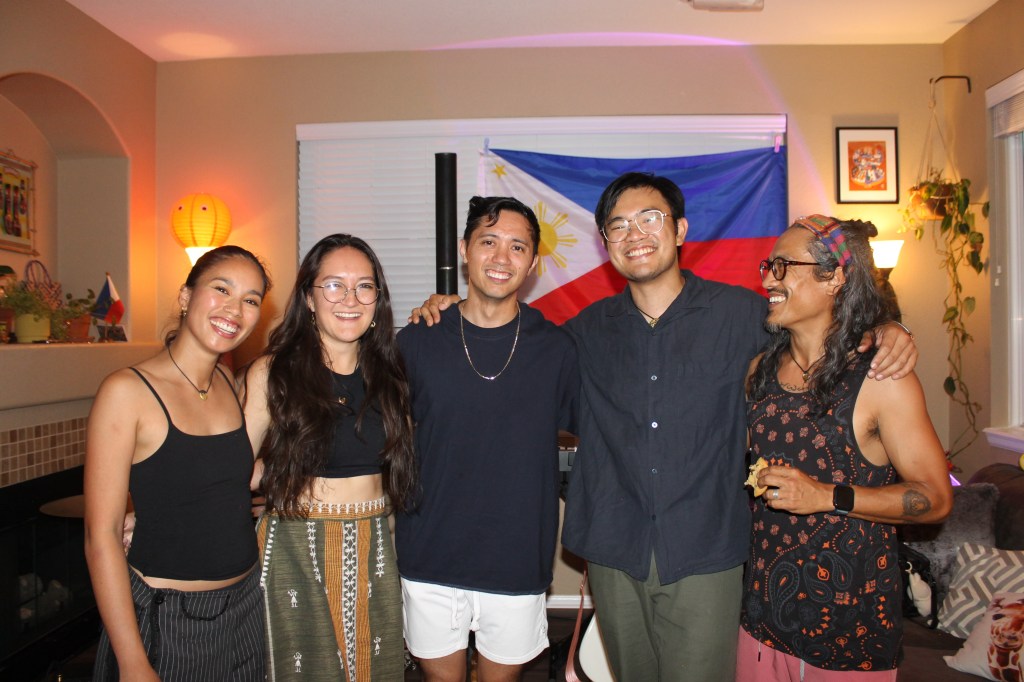
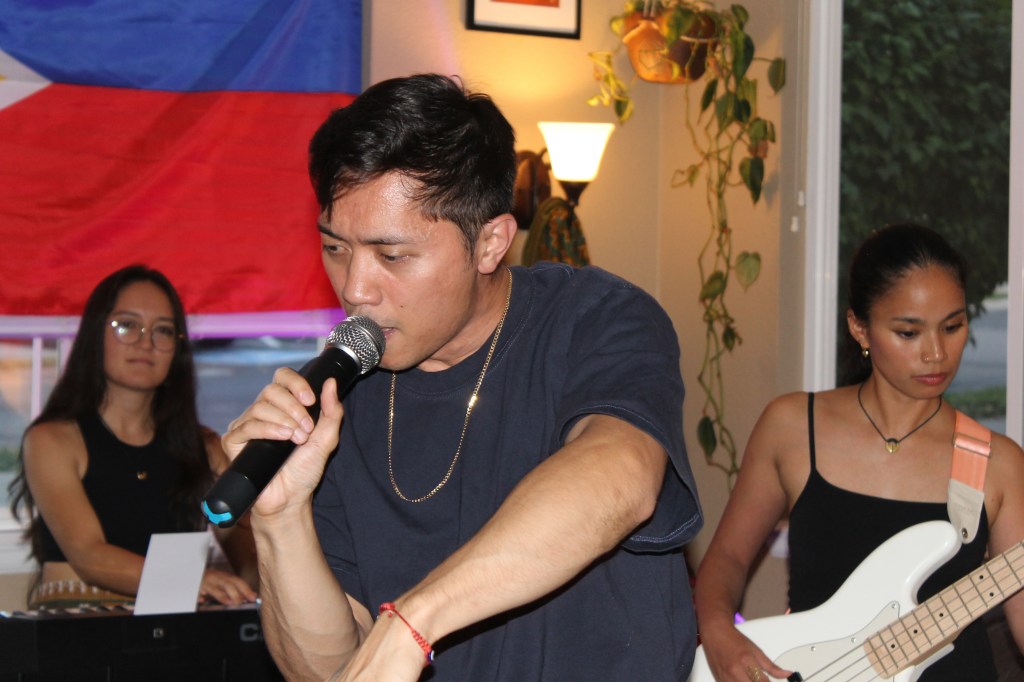
When rapper and poet Meta Sarmiento wanted to form a band after years of being a solo artist, he didn’t intentionally set out to recruit all Filipino musicians. But as a proud Filipino and member of the Filipino-American Community of Colorado, it’s fitting that he ended up creating Meta and the Barkada, an all-Filipino hip-hop band. He first contacted drummer Anthony Berenguel through the FACC to collaborate on a music video in 2024, but when he mentioned a potential band, Berenguel recommended a few other instrumentalists he knew through the FACC network. They became a five-piece band, with Sarmiento handling vocals, Berenguel on drums, Tommy Gatmaitan on guitar, Lianza Yap on bass, and Sarah Garcia on keys. For their live debut on Saturday, May 30, Meta and the Barkada are taking it back to where it all started, turning the FACC headquarters into a concert venue to close out Asian American and Pacific Islander Heritage Month in style.
Rather than jumping right into writing their own music, Meta and the Barkada started by rearranging songs from Sarmiento’s solo discography for a live band. But when they won Youth on Record’s Battle of the Bands in March, the free studio time prize prompted them to consider recording original songs. “There are times we would meet up and jam, and one of us will have an idea, and we all build on top of that, but there are also times when people will come in with an idea,” says guitarist Gatmaitan, whom the band calls the “ideas man.” Adds Sarmiento, “We have access to a studio where we can track now, so we’ve been tossing around new music ideas, and having conversations about what new music looks like. Not just Meta’s music, but what is Meta and the Barkada’s music going to be like?”
There’s no simple answer to that question. While they broadly consider themselves a “hip-hop band,” each member brings a different musical background and set of influences to the table. When bassist Yap gets asked what kind of music the band plays, people are often surprised by her answer. “They look at me and I say hip-hop and they’re like, ‘No way.’ But I feel like hip-hop is interesting because it’s kind of a combination of a lot of different genres,” she says. “Some of our songs are more slow, more R&B. ‘No ICE’ is more like a ‘90s hip-hop groove. [Some] are more rock.” Though they’ve never been beholden to a specific genre, Sarmiento does have his own point of reference: “When I think about a live band setup, I always had The Roots in my mind. Like, how do we capture that vibe, but with a little bit more edge, and a little bit more bite?”
Courtesy of Meta and the Barkada
Sarmiento’s primary goal is to use his music to shed light on the diverse experiences of Asian, Asian American and Pacific Islander communities. “Making music that’s authentic to the things that I’ve been through and the places that I represent, that’s been the driving force behind my lyricism and performance, and now the band too,” he says. “What our band represents is that there’s nuance in these personal experiences and histories. We don’t want to flatten the narrative anymore, we want to complicate the conversation.”
Meta and the Barkada is a testament to the fact that Asians and Pacific Islanders are not a monolith. Even just within the band, all five members represent different regions, languages and cultures that exist under the wide umbrella of Filipino identity.
Asian and Pacific Islander artists have not broken into mainstream hip-hop in the same way that many other groups have, but Sarmiento thinks that’s starting to change. “Hip-hop is a Black art-form first and foremost, full stop. It was rooted in Black resistance, breaking boundaries, and being anti-authority,” he says. “It’s the antithesis of the stereotypes that we’re often boxed into, which is that we’re quiet, submissive, we follow all the rules — we’re the model minority. I think that’s partly why Asians in hip-hop haven’t been as palatable through the years, because people weren’t ready to view Asians in that way.”
But the “model minority” stereotype doesn’t reflect the reality of their lived experiences. Sarmiento points to hip-hop’s popularity in places like the Philippines, with their own complex histories of resistance, adding that greater cultural awareness has expanded the possibilities for AAPI hip-hop artists today: “It makes sense that they love hip-hop, because hip-hop is a fight against oppressive structures and systems. I think the shift has begun because people are more open now, and there’s more access to our culture, and more importantly, our history.”
Courtesy of Meta and the Barkada
Despite their fairly recent formation, Meta and the Barkada have already been recognized for their impact. In addition to free studio time, the band won the title of “Denver’s Most Impactful Band” when they won Battle of the Bands, calling the honor “motivation” for their future. “I want us to be able to live up to it. We’re very conscious about how we impact the community,” Sarmiento explains. “Part of the reason we chose the FACC for our first show is because we’re all connected to the FACC, so it means something deeper for us. We’re also donating funds to the typhoon efforts in Micronesia. It’s never just for us–our wins will always be our community’s wins.”
Meta and the Barkada are excited (and a little nervous) to start sharing their music with a live audience. After their debut show on May 30, they’ll be gearing up to also play the Underground Music Showcase in late July.
“We don’t have the amount of experience performing in front of people that Meta does,” says Berenguel. “We’re all in FACC’s [performance group] Padayan Cultural, so we’ll perform at our own Filipino festival here and other events, but it’s different music–and it’s not UMS!” Sarmiento has faith that the shows will be a big success: “The energy that our crew carries onto the stage is just infectious. At the end of the day, we’re really just trying to have fun with everybody.”
Given that the first two ticket drops for the FACC show already sold out, they’re off to an auspicious start.
Meta and the Barkada, 6:30 p.m., Saturday, May 30, at the Filipino-American Community of Colorado, 1900 N Harlan St, Edgewater. Tickets are $17.85 online, and a portion of ticket proceeds will benefit Typhoon Sinlaku recovery efforts in Micronesia.
