

New school year, new policies from the Department of Education (DepEd).
That will be the case in public schools on June 8 as millions of Filipino students will start their classes for SY 2026-2027.
Teachers and school heads will have to navigate the implementation of various policy reforms that are ultimately aimed at addressing the country’s learning crisis, according to the DepEd.
But are schools ready for these? Here are some expected policy shifts:
Three-term system begins
President Ferdinand Marcos Jr. approved the switch from a quarterly to a three-term school calendar in March to mainly address “the long-standing issue of compressed learning periods caused by class suspensions due to natural hazards and overlapping major events.”
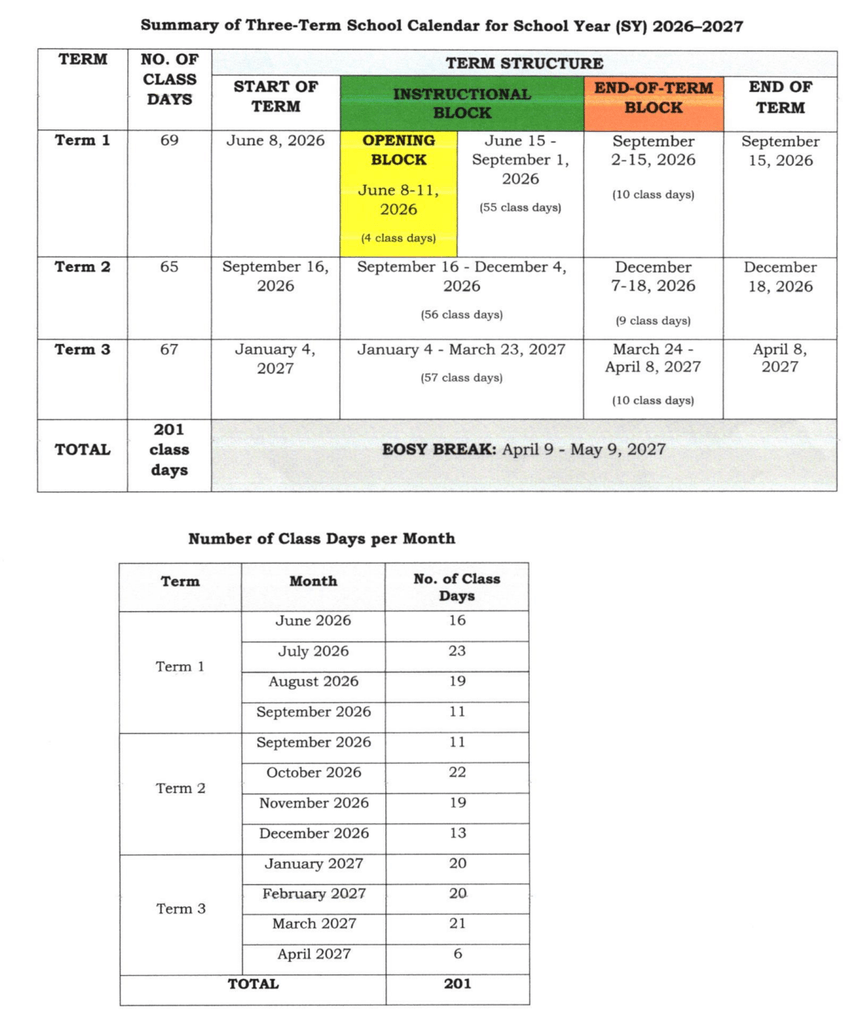
Beginning SY 2026-2027, there will be a 201-day calendar, with terms spanning 65 to 69 days.
Only for the first term, the first week or opening block will be devoted to school opening activities, such as orientation sessions, learner profiling, baseline assessments, and other administrative processes.
Lessons, learning activities, and examinations will be done in the instructional block, the longest block in each term.
A nine- or 10-day end-of-term block will cap each term. Various school and DepEd activities will be scheduled here, along with report card distribution, a five-day period for the agency’s remediation thrust — particularly the Academic Recovery and Accessible Learning (ARAL) Program — parent-teacher conferences, and wellness breaks, among others.
“We also do not want anyone to think that we are only after academics. Activities…really play an important role in the development of a learner — leadership development, self-confidence, and all these communication skills,” Education Undersecretary Carmela Oracion told Rappler regarding the end-of-term block.
The Second Congressional Commission on Education (EDCOM 2) previously found that celebrations and contests overcrowded the school calendar and took time away from learning core subjects.
Term 1 of SY 2026-2027 will end on September 15, followed by Term 2 from September 16 to December 18. Term 3 will be from January 4 to April 8.
For now, the three-term school calendar is optional for private schools.
‘Simplified’ lesson planning
To align with the new school calendar, Oracion said lesson planning has been simplified, with the template containing the following:
- Intentions – curricular targets, clear expectations, and learners’ context
- Learning experience – lesson flow and opportunities for integration into other subjects
- Assessments
- Ways forward – reflection activities and extended learning opportunities outside the classroom
“Check-ins should be very regular to really see whether the students are able to comprehend what we are teaching without waiting for the last minute,” she said of the planned assessments.
In a May 18 congressional hearing, Education Assistant Secretary Jerome Buenviaje also said that the new lesson planning guidelines give teachers flexibility to adjust depending on the progress of the class. Lessons not taken up during a particular term can be integrated into the next term.
During the same congressional hearing, the Alliance of Concerned Teachers and the Teachers’ Dignity Coalition asked the DepEd for the recommended minimum lessons that must be taught, known by the sector as the “most essential learning competencies.” The agency has yet to provide this.
Buenviaje said it is important for schools to come up with their own inventories of what lessons have been taught during the term and coordinate with their schools division offices regarding these inventories.
He also said teachers must catch students having difficulty keeping up with their lessons by the fifth week of a term. ARAL or remedial sessions may be done after classes during the instructional block, and then for a straight five-day period by the end-of-term block.
Through the three-term system, Buenviaje said the DepEd seeks to secure at least 163 days of “solid teaching,” as they already expect that there will be no lesson delivery during the opening week.
Education officials, however, were previously urged to reach at least 180 learning days.
New grading system
The DepEd will also be moving forward with a new grading system starting SY 2026-2027.
While there will still be a transmutation table, a student must now attain a raw score of 70 to 72.99 to get a passing grade of 75. Previously, a raw score of 60 would be transmuted or converted to 75.
EDCOM 2 had flagged that grade transmutation contributed to mass promotion, as it “[masked] the depth of [students’] learning gaps in school records.”
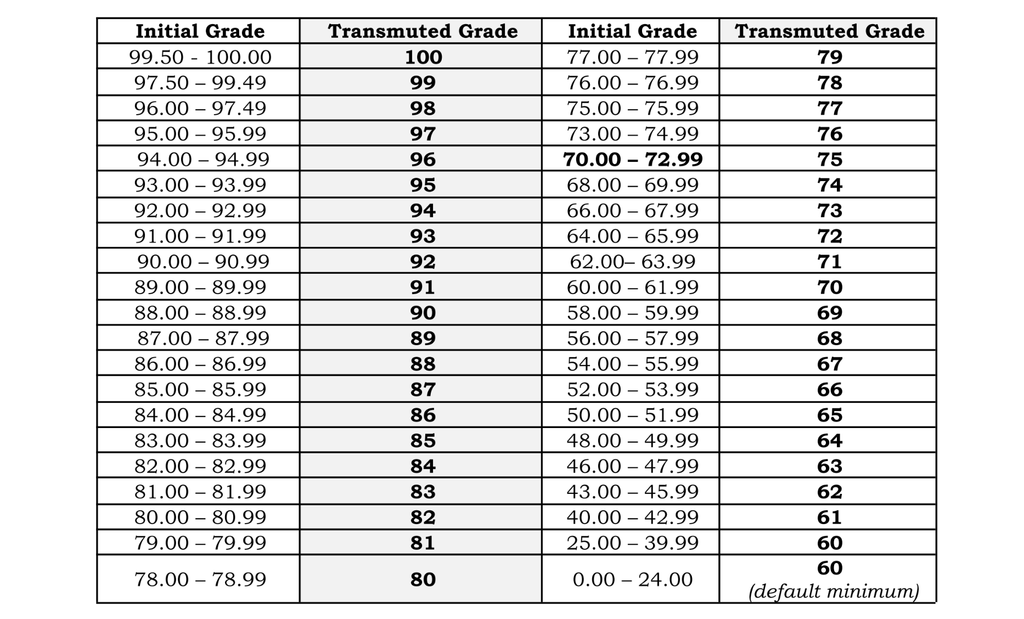
The adjusted transmutation table serves as the DepEd’s transition to a zero-based grading system that will be implemented by SY 2027-2028. This system means students will receive their exact raw scores, without transmutation.
Teachers will also administer two summative or achievement tests per term: the first covering the first 15 instructional days and the second covering the next 15. On top of these, a term examination will be conducted in the last week of the instructional block.
For example, the DepEd’s calendar shows that teacher-made summative tests for the first term are expected on July 6 and July 28, while the term examination would be on August 28 and September 1.
Revised SHS curriculum
The full implementation of the Strengthened Senior High School Program or the revised SHS curriculum for both public and private schools nationwide will get underway in June.
Under the revised SHS curriculum, the four tracks (Academic, Technical-Vocational Livelihood, Sports, and Arts and Design) were reduced to two (Academic and Technical-Professional or Tech-Pro).
Core courses were reduced from 15 to five, namely Effective Communication/Mabisang Komunikasyon, Life Skills, General Mathematics, General Science, and Pag-aaral ng Kasaysayan at Lipunang Pilipino. These will only be offered during Grade 11.
Students are free to choose the electives that would match their interests and goals, even electives from the track they did not select, unlike in the previous curriculum where students could only take subjects in their chosen strand.
Nearly 900 schools that were part of the pilot test last school year will continue to implement the revised curriculum for Grade 12, which features longer work immersion hours. Tech-Pro Track students are required to have 320 hours of work immersion.
Work immersion is optional for Academic Track students, who are most likely to pursue higher education. They are instead recommended to undergo field exposure for 80 hours.
Feedback mechanism
Some teachers’ groups have been asking the DepEd to pilot-test the three-term school calendar instead of doing a full rollout, arguing that the policy reforms may overwhelm teachers.
EDCOM 2 also posed various questions to the DepEd during congressional hearings. Issues raised by the commission for the three-term calendar include the lack of explicit measures to protect Term 2 from rainy season-related class suspensions, the need for guidance on how schools should handle numerous celebrations and contests, and the need to ensure effective remediation to help struggling learners.
Asked how the DepEd would handle feedback, Oracion told Rappler, “If along the way, during the implementation, we see things that need to be improved, then we work on them.”
The DepEd also said teachers may send their questions and clarifications through the agency’s online monitoring tool, which was presented during orientation sessions for regional and division officials, school heads, and teachers. – Rappler.com
