

“We lived another day.”
A visibly relieved Senate President Alan Peter Cayetano said this to reporters after the plenary session on Monday, May 18. That day, there were reports of another coup exactly seven days after Cayetano was installed as Senate president, ousting Senator Tito Sotto.
Reporters were agitated that Monday morning. They roamed the halls of the Senate, rushing from one office to another, closely tracking senators’ movements and counting who was meeting whom.
That morning, Cayetano, a born-again Christian, was in what he called “an assembly of people who love God” — the Luzon Evangelical Leaders’ Fellowship for “prayer and Senate direction.” He shared to the group that he had an exchange of Bible verses with ally Senator Joel Villanueva, son of the founder of the Jesus Is Lord Church.
“For we are powerless against this great multitude that is coming against us. We do not know what to do, but our eyes are on you,” read Villanueva’s message to Cayetano, quoting 2 Chronicles 20:12.
Cayetano replied with Deuteronomy 31:8: “The Lord himself goes before you and will be with you; he will never leave you nor forsake you. Do not be afraid; do not be discouraged.”
“We do feel the forces ganging up on us,” Cayetano said.
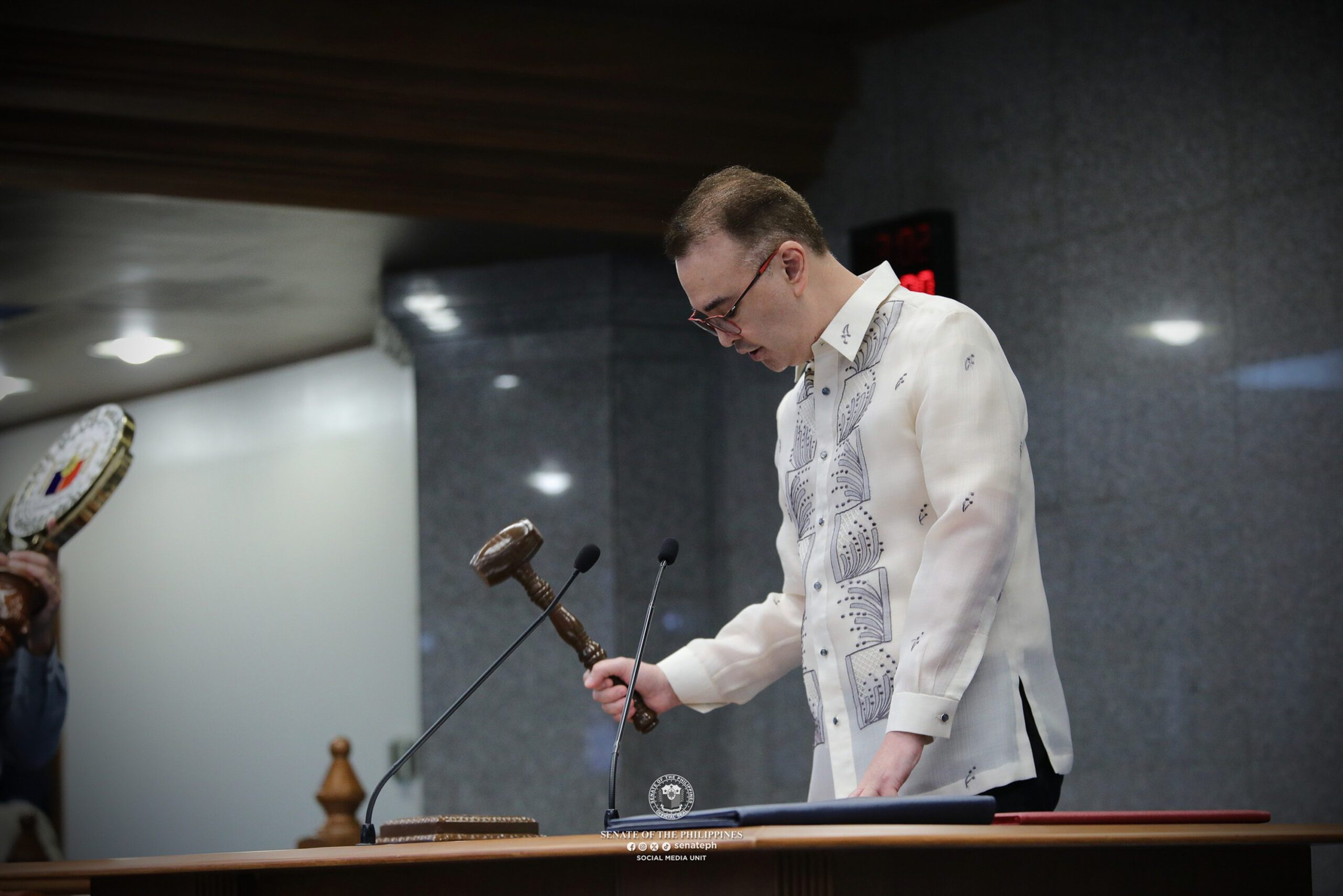
Cayetano joked that the day might mark either the beginning of his tenure or his despedida (farewell). Everyone in the room laughed.
Cayetano said he would remain as the Senate president if that was God’s will. “One day, I’ll leave this office (of Senate president). Maybe today. Maybe a month from now. Maybe after the impeachment. Who knows?”
“[If] everything goes the way we thought it would go, then we will be convening as an impeachment court, and I’ll take my oath. If it doesn’t, you’re witness to history,” he told the Church preachers.
Cayetano’s Senate presidency survived that day. And by keeping the post on Sunday, May 24 — his 13th day in office — he escaped the distinction of becoming the shortest-serving Senate president in Philippine history. Camilo Osias holds the record for the shortest single-term Senate presidency in the country, serving for just 13 days, from April 17 until April 30, 1952. Osias, an educator and writer from La Union, was later replaced by Eulogio A. Rodriguez.
The Senate holds regular sessions Monday to Wednesday, and leadership changes cannot happen without one.
Now the question hanging over the chamber is whether Cayetano will survive Day 14, when the Senate reconvenes on Monday, May 25.
Plotting a Senate coup
The May 11 Senate coup took weeks of planning. Cayetano wasn’t the top choice for Senate president.
Two months before he took his oath, the odds were heavily against him. A group of 14 senators had already signed papers supporting a different senator for Senate president, Cayetano told evangelical leaders on May 18.
But according to Cayetano, former Senate president Chiz Escudero was backing him. Cayetano, however, asked Escudero if his older sister — Pia — could instead be considered as Senate president in the coup they were plotting.
Cayetano thought this was a smart move. He felt Pia was friendlier and had fewer enemies in the Senate. Cayetano hoped her charm, combined with Escudero’s connections, could convince two or three senators to switch sides, breaking the rival group’s majority.
But Escudero rejected the idea of Pia being the Senate president. According to Cayetano, Escudero told him to persuade other senators.
“He told me, ‘No, simple. Go around the 12.’ And he said some names. Sabi niya, ‘Ito ‘yung mga medyo marupok or vulnerable, go to them. If they say yes, then go,” Cayetano revealed.
The “vulnerable” senators would turn out to be the Villar siblings, Mark and Camille, and Loren Legarda. Cayetano secured their vote.
One Saturday night, Cayetano said God supposedly gave him this impression. “Alan, you trust Chiz, Chiz trusts Joel, Joel trusts Loren, Loren trusts…but you don’t trust each other.”
That, he said, made him realize they all needed to sit down together at one table.
“Although you trust each other individually, it becomes easy for distrust to creep into the group,” he said.
Cayetano told the same evangelical leaders that on one Sunday, he gathered 12 senators — including himself — around one table. He did not specify whether the meeting took place exactly a day before the coup.
To get the winning 13th vote, Cayetano needed Senator Ronald “Bato” dela Rosa, who had been absent at the upper chamber for the last six months amid reports of an International Criminal Court (ICC) warrant for his arrest.
Dela Rosa, former police chief and architect of Rodrigo Duterte’s drug war, was afraid to show up at the Senate unless he was absolutely sure that the Cayetano bloc would win.
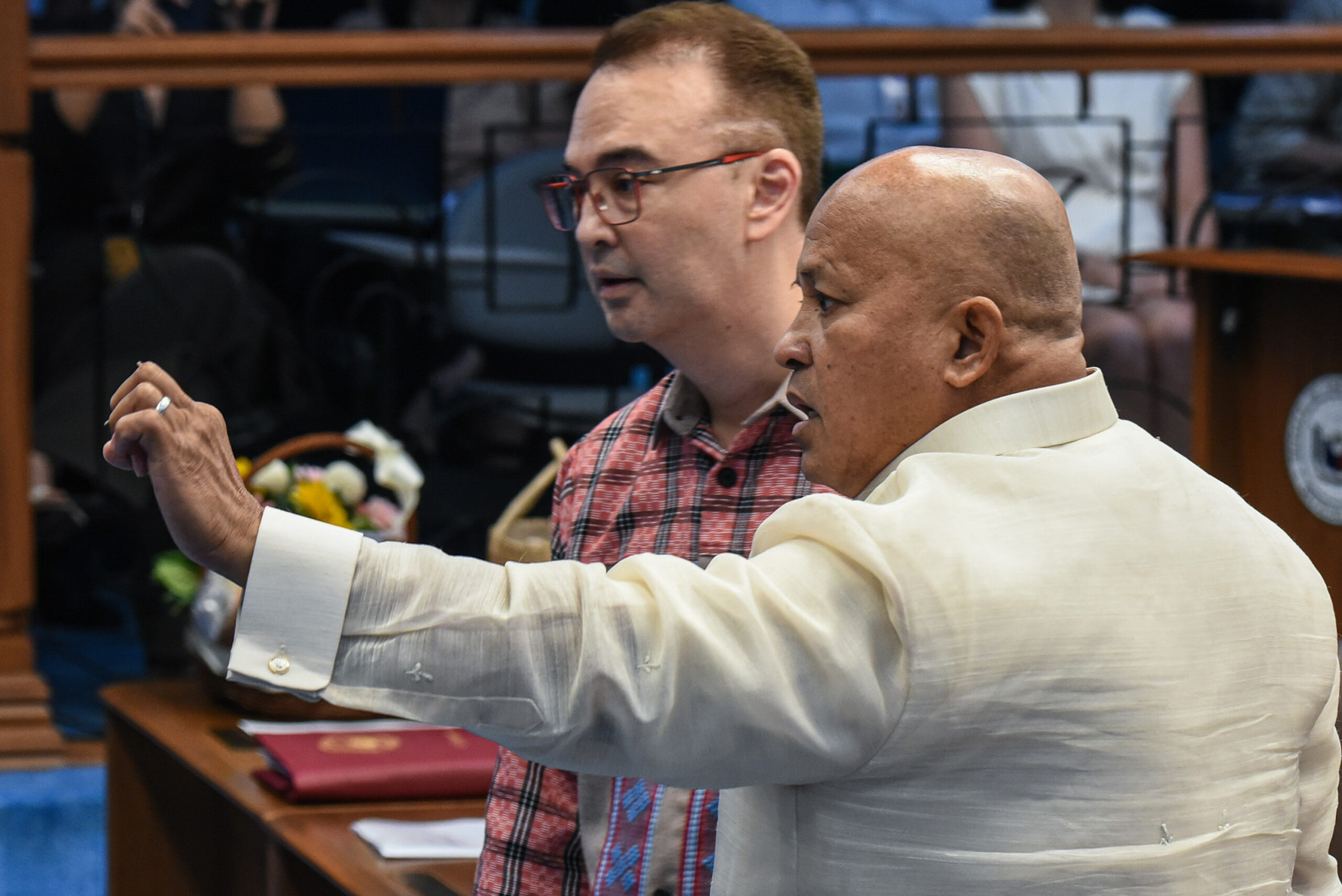
The Saturday before the coup, Dela Rosa called Cayetano. Worried about police checkpoints, he said, “Hindi na rin ako pupunta kung hindi rin tayo 13 (I won’t go if we aren’t 13).”
Cayetano pushed him to help, saying, “Sir, pang-labing apat siya (unnamed senator), pang-13 ka.” (He is the 14th, you are the 13th.)
Dela Rosa later agreed. He even used Cayetano’s car to get to the Senate on May 11, to cast his vote. In the Senate, Cayetano promised Dela Rosa “protective custody.”
Rise to the rostrum
Cayetano’s ascent to the Senate presidency was marked by surprises and controversy.
At 2:59 pm on May 11 — barely a minute before the session began — Cayetano assured reporters there would be no leadership change intended to derail the impeachment proceedings against Vice President Sara Duterte.
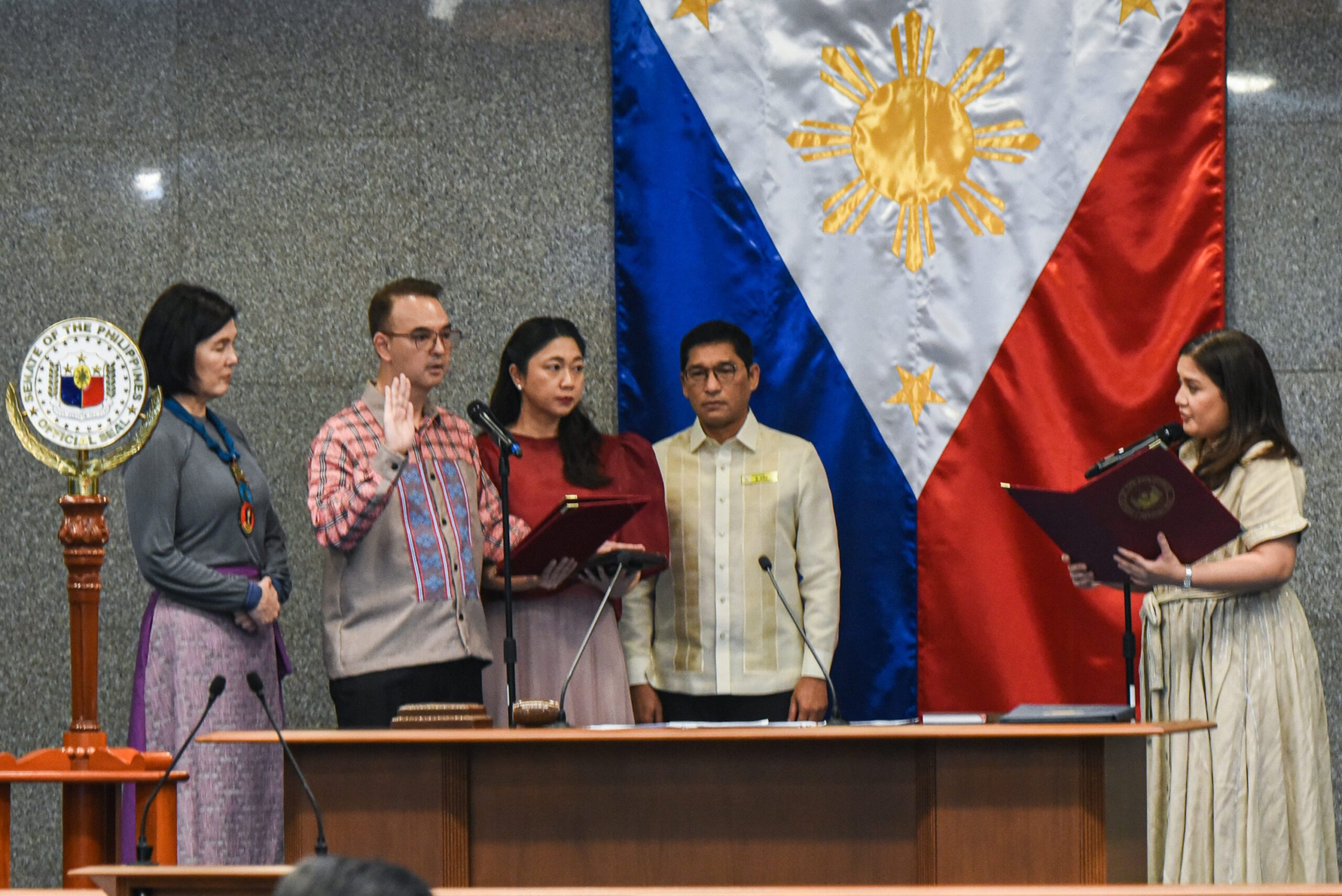
Then, 10 minutes later, Cayetano took the podium to inform Sotto that 13 senators wanted him removed as Senate president. Senate tradition dictates that the incumbent is informed about this at 12 noon of that day, but it became clear why this was not followed.
After six months of absence at the upper chamber, Dela Rosa suddenly appeared to participate in the vote. He arrived in a rush, evading agents of the National Bureau of Investigation (NBI) who attempted to serve an International Criminal Court warrant tied to crimes against humanity charges stemming from Rodrigo Duterte’s bloody war on drugs.
In his first speech as Senate president, Cayetano said, “In every crisis, there are big winners and big losers.” He was referring to the economic crisis faced by the country, which was intensified by the conflict in the Middle East. “Unfortunately, it is the poorest of the poor who are always the losers,” he added.
Then came a series of internal crises at the Senate. On May 13, the chamber went on lockdown to shield Dela Rosa from a possible arrest. Gunfire rang out in the upper chamber during a confrontation between Senate security personnel and agents from the NBI.
After the standoff, Dela Rosa — who had sought refuge in the Senate for three days — escaped.
Crisis leader
As the shooting incident unfolded, Cayetano went live on Facebook. “This is the Senate of the Philippines, we are allegedly under attack,” he broadcasted.
Holding his phone in a darkened room, his face illuminated by a single light, he questioned why other government agencies were supposedly targeting the Senate — without first validating this with the concerned agencies.
The NBI and the Senate security have conflicting narratives on what transpired.
For Cayetano, the Senate was under attack. When asked by the media if the standoff was staged and a diversionary tactic to facilitate Dela Rosa’s escape, Cayetano went ballistic.
“I don’t think there’s any question, the Senate is under attack…was under attack!” Cayetano said as he banged the podium with his hand during a Senate press conference on May 14.
For Interior Secretary Jonvic Remulla, however, the evidence showed “there was no attack on the Senate.” The investigation showed that 36 out of the 44 bullet shells were recovered from the Senate, meaning most of the shots were fired from the side of Senate security.
Former Senate President Franklin Drilon described the incident as a failure in leadership for both the Senate and Malacañang.
“This is a collective failure of leadership. I do not know where we have gone wrong. Was it the elections? Was the process of our election not correct? Is it flawed? Why are we facing this situation where we do not respect anything, we do not respect the law,” Drilon said in an interview with DZBB. “It’s a shame already, it’s embarrassing for all of us.”
Common denominator
The Duterte family binds Cayetano’s coalition together.
There is Dela Rosa, the former police chief of Rodrigo Duterte, who is now detained and under the custody of the International Criminal Court over crimes against humanity allegations tied to the drug war.
There is Bong Go, Duterte’s longtime aide. Other senators in Cayetano’s bloc also benefited from endorsements by Rodrigo or Sara Duterte during their campaigns.
Cayetano himself was Rodrigo Duterte’s running mate in 2016. Under Duterte, he served as foreign affairs secretary before later becoming House speaker.
As foreign affairs secretary, Cayetano — who often peppers his speeches with Bible verses and invocations of God — defended Duterte’s bloody drug war, which killed thousands of people.
Yet Cayetano insists the alliance is not about protecting anyone.
“We’re not here for or against anyone,” he said. “We’re here to do our job.”
Now these same senators are set to serve as senator-judges in the impeachment trial of Sara Duterte — once an ally of Ferdinand Marcos Jr., now his fiercest political rival. Despite the impeachment case, Sara remains a leading contender in the 2028 presidential race, based on recent surveys.
Some members of Cayetano’s majority bloc are also facing allegations ranging from multibillion-peso infrastructure corruption and market manipulation to plunder tied to campaign donations.
When Cayetano reclaimed the seat of power, the people who voted for him were rewarded with committee chairmanships.
‘God’s will’
A week after the takeover, Cayetano acknowledged that negotiations between rival camps were continuing.
“There were meetings that took place, calls from both sides — there were enticements, there were threats,” he said.
Calls for his resignation intensified after the shooting incident inside the Senate. Cayetano dismissed many of his critics as political operators, saying he had grown accustomed to such attacks during his stint as House speaker and Duterte’s foreign affairs secretary.
After all, Cayetano was no stranger to leadership coups. He had been on both ends of one — as both the ousted and the one who ousted. In 2020, he was removed as House speaker and replaced by Lord Allan Velasco.
Duterte had brokered a term-sharing agreement between Cayetano and Velasco back then. Cayetano supposedly would serve as speaker during the first half of the term, before yielding the post to Velasco. But Cayetano resisted stepping down, triggering a bitter leadership struggle in the House.
During the session on Wednesday, May 20, Senator Erwin Tulfo, a member of the Sotto bloc, delivered a prayer — a pointed message — to the chamber.
“There are times when personal interests, or the interests of a party or group, come first. We ask for guidance from our loving God. Enlighten our minds and open our eyes so that we may put the needs of our fellow citizens first, because they look to us to help and resolve the nation’s problems,” Tulfo said.
“Grant us the courage to sacrifice for the good of the country, and not for ourselves or our allies. Amen,” he added.
![[Vantage Point] The day the Senate died](https://www.rappler.com/tachyon/2026/05/THE-DAY-THE-SENATE-DIED-MAY-23-2026.jpg?fit=449%2C449)
In a privilege speech that same day, Senator Risa Hontiveros said the Senate “has sustained a profound injury to its dignity, credibility, and moral authority before the Filipino people” following the shooting incident.
“Ganito na ba talaga kababa ang inabot ng pulitika sa Pilipinas? Ito na ba tayo, Mr. President?” Hontiveros asked. (Has Philippine politics really sunk this low? Is this what we have become, Mr. President?)
The alliance keeping him in power remains fragile. Each Senate session carries the possibility of another upheaval.
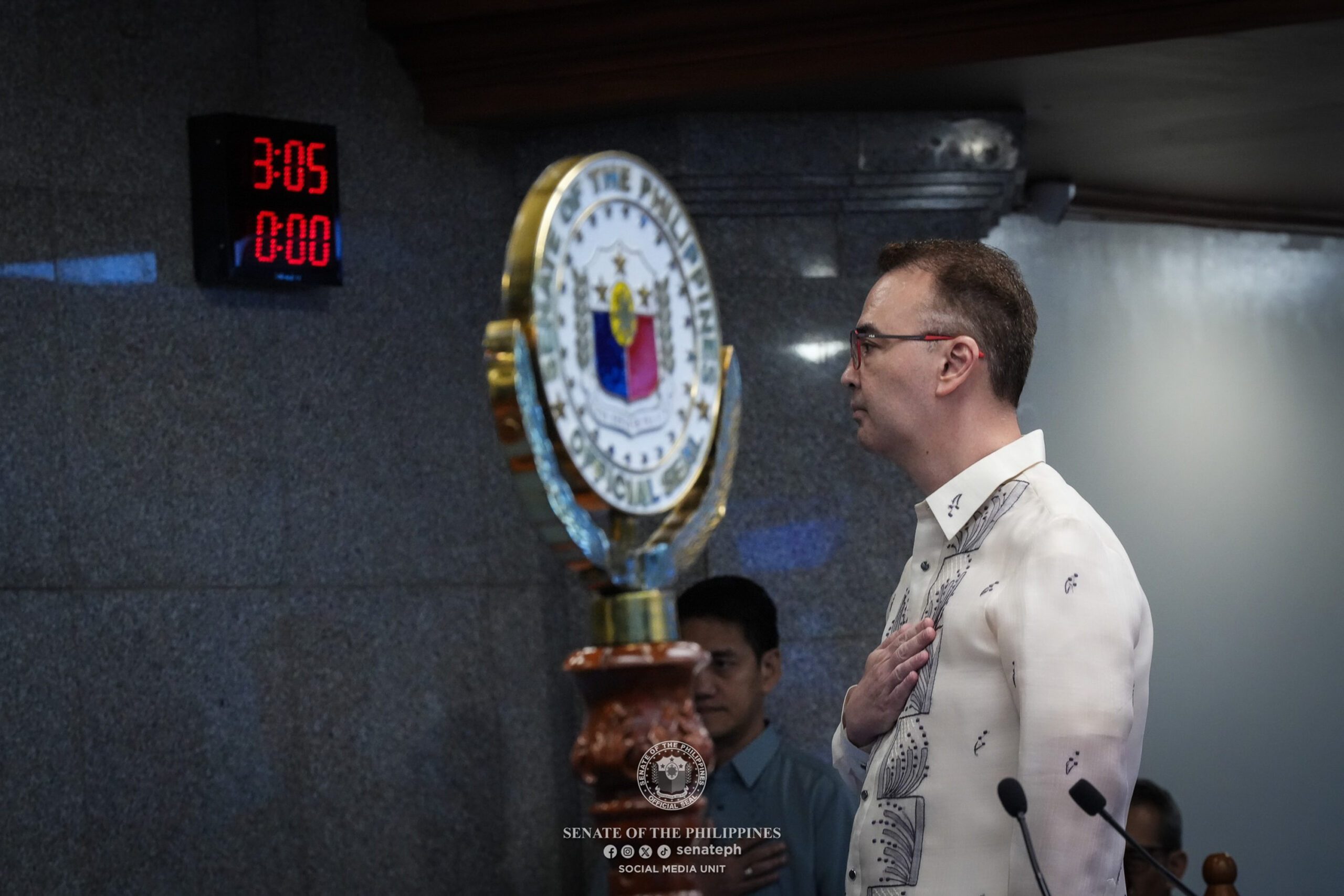
Senator Sherwin Gatchalian, a member of the minority bloc, is being floated as a possible replacement for Cayetano. Members of the minority bloc — which they call the “Solid Bloc 11” or SB11 — are also backing the senator from Valenzuela to “restore the damaged image of the Senate.”
Cayetano seems pretty much aware of it. During a plenary session, Cayetano jokingly said, “I might vote for him (Gatchalian) one day.”
Still, Cayetano speaks like a man who believes he has already reached the summit of his political career.
“I’ve reached the pinnacle of my career,” he said at the May 18 forum with evangelical leaders. “From councilor to vice mayor, congressman, House speaker, secretary of foreign affairs, and now Senate president. Ano pang hihingin ko sa mundong ito (What more could I ask from this world)?”
Cayetano said he is prepared to step down as Senate president at any moment if that is God’s will.
“If the Lord gave me an eight-day mission, Monday to Monday, so be it. I’m happy; don’t worry about me. But if he’s giving me a 30-day mission, a 45-day mission, everything else is vanity,” he said.
The question hanging over the Senate is how long Cayetano’s “mission” will take to finish.
As Lacson described it, the Senate presidency is “the most unstable job in the world.” – Rappler.com
