

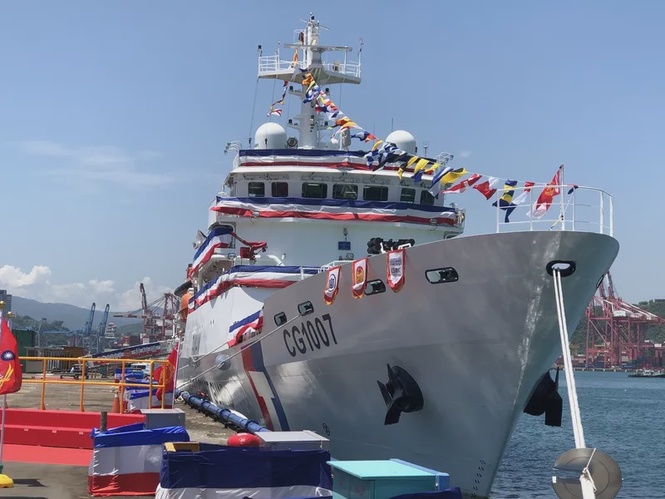
Taiwan’s coast guard has spent the past two years quietly building a network of relationships across Southeast Asia, posting liaison officers in the Philippines, Indonesia and Thailand and possibly expanding that footprint to Vietnam and India. At the same time, the Philippines has sent sitting officials to Taiwan’s flagship international ocean forum for two consecutive years, a shift that would have been unthinkable before Manila eased decades of restrictions on contact with Taipei. Together, the moves point to a deepening relationship between Taiwan and its neighbors to the south on maritime governance, one built less around formal alliances than around information sharing and a shared interest in exposing China’s gray zone tactics at sea.
The Philippines Keeps Sending Sitting Officials To Taiwan’s Ocean Forum
Taiwan’s Ocean Affairs Council has run its Taiwan Ocean International Forum every year since 2020, and this year marked the sixth edition. Philippine participation is nothing new, but 2025 brought a clear break from the past.
A 35 Year Old Restriction Quietly Falls Away
According to reporting from Storm Media, Philippine President Ferdinand Marcos Jr.’s office issued an administrative memorandum in April 2025 easing restrictions on contact with Taiwan that had stood for 35 years. Under the new rules, every Philippine official except the president, vice president, foreign minister and defense minister can now visit Taiwan on an ordinary passport without using an official title.
Barely two months after the memorandum took effect, three sitting Philippine officials showed up among the international guests at last year’s forum: Jay Tarriela, spokesperson for the Philippine Coast Guard on West Philippine Sea affairs, Philippine Navy Commodore Roy Vincent Trinidad, who holds the equivalent role for the navy, and Michel Andre P. del Rosario, deputy secretary general of the National Security Council. All three were formally listed as scholars or experts rather than officials, but Trinidad told the forum that the Philippine government has taken a firm stance on defense diplomacy in recent years, including on maritime issues and cooperation with regional partners, which he said was why he, Tarriela and the rest of the Philippine delegation had come.
Tarriela himself was slated to join this year’s forum remotely to discuss how the Philippines is responding to China’s gray zone activity in the South China Sea, though the video link ultimately did not happen. Organizers describe him as the Philippines’ point person on the front line of that effort, someone who has turned encounters with Chinese coast guard vessels, maritime militia boats, dangerous blocking maneuvers and supply interdiction attempts into documented, internationally visible events through video footage, real time press briefings and sustained engagement with foreign media, a strategy built on transparency rather than confrontation.
Taiwan’s Coast Guard Liaison Officers Are Already Spread Across Southeast Asia
Speaking at the Taiwan-Asia Exchange Foundation’s eighth anniversary forum earlier this month, Ocean Affairs Council Deputy Minister Sung Cheng-en argued that Taiwan Strait security, Taiwan’s international status and Taiwan’s survival are inherently international matters, whether viewed through history or present day fact, and that the international community’s stake in Taiwan is only growing rather than shrinking.
Sung pointed to China’s claim of jurisdiction over waters east of Taiwan as a recent example of that dynamic playing out. The claim drew public concern from a number of countries, and the United States, he said, “put it more plainly,” making clear it would not allow any single country to overreach into the order governing waters east of Taiwan. Sung said Washington also credited Taiwan directly, noting that Taiwan, not any other government, has managed those waters for more than 70 years, which undercuts the legal basis behind Beijing’s claim. When China pushes an exclusive jurisdictional claim like that, he added, the international community tends to speak up against it, which is exactly why he considers Beijing’s effort to frame Taiwan as a purely domestic matter a thankless, uphill task.
Sung also confirmed that Taiwan’s coast guard liaison officers are currently concentrated in Southeast Asia, covering Indonesia, Thailand and the Philippines, with Vietnam and India both under consideration for future postings.
Washington Draws A Clearer Line On China’s Coast Guard
Washington’s own position on China’s maritime gray zone activity has hardened as well, a shift visible in Secretary of State Marco Rubio’s language this past July. Rubio attended the ASEAN foreign ministers’ meeting in the Philippines on July 22 and held a 90 minute meeting with Chinese Foreign Minister Wang Yi on the sidelines. According to reporting cited from the New York Times, Rubio criticized recent “aggressive encroachments” by Chinese coast guard vessels in waters near Taiwan during that meeting, telling Wang directly that Washington does not accept such actions and considers them at odds with the “strategic stability” both sides say they are trying to maintain.
Kuo Yu-jen, deputy president of the Institute for National Policy Research, said in an earlier interview that Rubio’s comments amounted to a clear signal that the United States will not simply stand by, meaning Washington is prepared to get directly involved whenever China applies gray zone pressure against the Philippines, Taiwan, Japan or even South Korea. That, Kuo said, changes the strategic picture entirely.
