

Mynt’s historic IPO on October 20, 2026, was significant for more than the ₱60.9 billion it raised. It brought one of the Philippines’ most recognizable technology and financial-services businesses into the public market — and gave international investors another reason to look at Philippine equities.
Just ten days after listing, Mynt (PSE: GCASH) had already established itself among the country’s largest publicly traded companies.
At its October 30 closing price of ₱6.61 per share, Mynt had a market capitalization of approximately ₱442.2 billion, equivalent to around US$6.9 billion. It ranked as the Philippines’ seventh most valuable listed company, behind Manila Electric Company at ₱476.8 billion, but ahead of Ayala Corporation at ₱331.9 billion and Aboitiz Power at ₱319.2 billion.
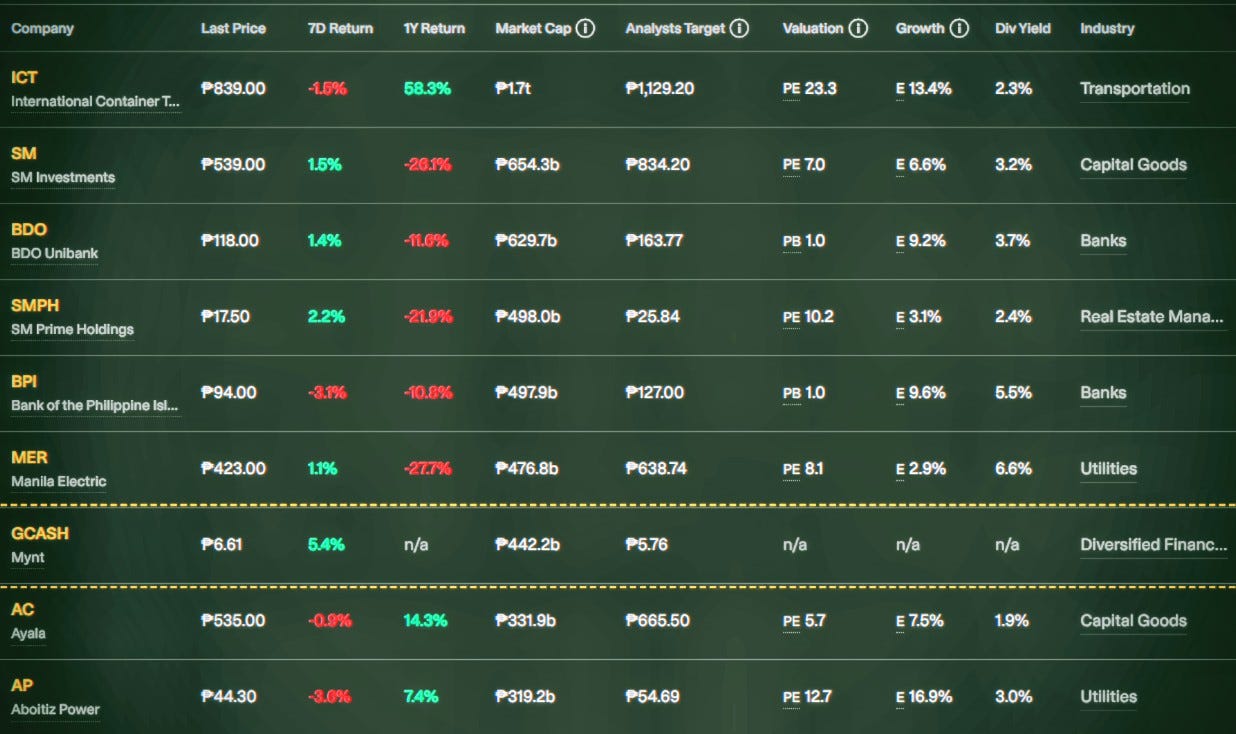
That is a remarkable position for a newly listed company.
Mynt also stood out in the week ending October 30.
Its market value increased by approximately ₱22.7 billion, or 5.4%, making it the leading market-capitalization gainer among Philippine listed companies over the period, based on the figures compiled for this analysis. It edged out MREIT, which added ₱22.5 billion, while SM Prime Holdings gained ₱10.8 billion.
This increase represents a rise in the market value of existing shares — not cash raised by the company or realized gains for shareholders. Nevertheless, it demonstrates how quickly a large new listing can become an important part of the market.
Mynt’s growing international visibility is another encouraging development.
According to TradingView’s fund-holdings data, four US-listed exchange-traded funds (ETFs), traded on the Nasdaq and New York Stock Exchange, hold Mynt shares:
Nomura Focused Emerging Markets Equity ETF (EMEQ): 0.14% portfolio weight
Baron Emerging Markets Select ETF (BCEM): 0.24%
Baron Financials ETF (BCFN): 0.23%
T. Rowe Price Emerging Markets Research ETF (TEMR): 0.10%
These funds provide US investors with an indirect way to gain exposure to Mynt through familiar, US-listed investment vehicles, without having to purchase shares directly on the Philippine Stock Exchange.
The individual portfolio allocations are relatively small, and ETF holdings and weights can change. Still, the significance is that Mynt has entered the investment universe of established international fund managers.
This is one of the benefits of becoming a public company: a business can gain access not only to domestic investors, but also to international capital through investment funds and global financial platforms.
Mynt’s IPO also highlights how much room the Philippine capital market has to grow.
According to ASEAN Exchanges, the Philippine stock market had a total market capitalization of approximately US$313.7 billion and 280 listed companies as of September 30, 2026. Vietnam, by comparison, had a market capitalization of US$352.7 billion and 704 listed companies. Singapore had 604 listed companies.
Mynt’s roughly US$7 billion IPO valuation added a substantial new company to the Philippine market, but it does not erase the gap.
The comparison is particularly revealing because Vietnam’s market is now larger despite having an economy and capital-market development trajectory different from the Philippines. Singapore, meanwhile, demonstrates how a deeper pool of listed businesses can help establish a market as an international investment destination.
The Philippines does not simply need a larger stock-market index. It needs more productive, profitable, and well-governed businesses willing to list, raise capital, and grow.
A strong capital market is not built around one company, regardless of how prominent that company may be. It is built through a broad collection of businesses across technology, financial services, manufacturing, infrastructure, healthcare, consumer industries, and other sectors.
More successful listings would give Filipino savers more opportunities to participate in the growth of local enterprises. They would also give international investors a wider selection of Philippine businesses in which to invest.
For companies, the public market offers access to long-term capital, greater visibility, liquidity for shareholders, and the discipline that comes with public ownership.
Mynt has demonstrated that a Philippine business can attract substantial capital and command international attention. Its market value and share-price performance will, of course, continue to depend on its business results and future prospects.
But its contribution to the Philippine capital market is already worth recognizing.
The real success of Mynt’s IPO will be even greater if it inspires more Philippine companies to follow.
The country needs more businesses that can grow, compete internationally, create jobs, and become valuable public companies. More GCash-sized success stories would mean a deeper stock market, broader investment opportunities, and a stronger channel for turning Filipino savings into productive capital.
That is the bigger opportunity for the Philippines.
