

In the first week of Advent, we considered the threshold of the “I don’t know,” leaving behind our yearning for certainty and learning to live with mystery. This necessary step hopefully led us to the second week of Advent and the next threshold: from old images of God to new ways of relating with him. In the third week of Advent, we tried to cross the threshold of the “me” and venture into the “we,” from isolation and self-sufficiency to connection and community. All these thresholds have been preparing us for the challenge of the fourth week of Advent…
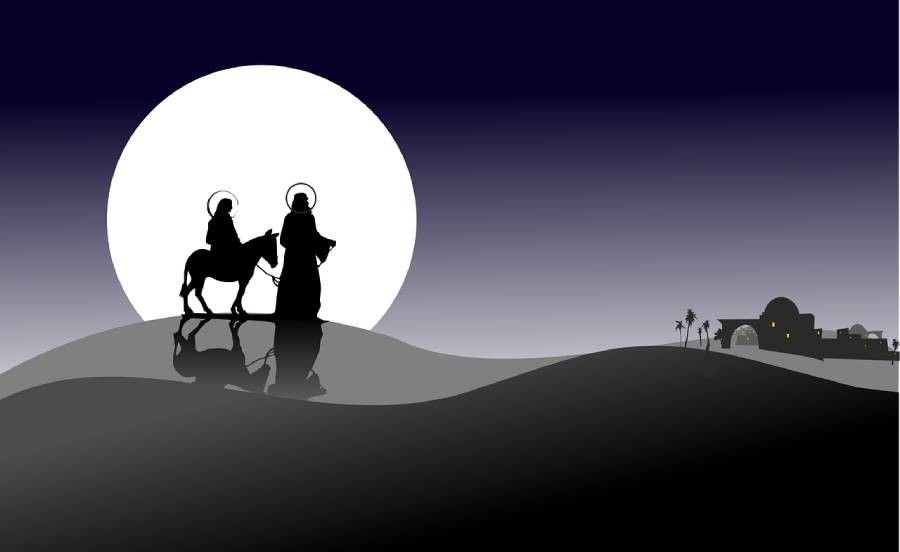
Our Gospel today (Matthew 1:18-24) grants us a glimpse of Joseph’s dilemma: “When his mother Mary was betrothed to Joseph, but before they lived together, she was found with child through the Holy Spirit. Joseph, her husband, since he was a righteous man yet unwilling to expose her to shame, decided to divorce her quietly.”
Read the last sentence again. What was motivating Joseph’s actions? Because “he was a righteous man,” we can surmise that it was the desire for righteousness. But what is righteousness? The Law is certainly a part of being righteous. But it is not enough.
In Deuteronomy 22, if a woman betrothed to a man is found to have had relations with another man, she could be dragged to the entrance of her father’s house and there be stoned to death. Joseph went beyond the Law and practiced compassion. He would forego what the Law allowed and instead divorce Mary quietly. Righteousness also involves kindness and mercy.
But how would this righteous act save Mary? A theory: Perhaps Joseph thought that by divorcing Mary with as little drama as possible, the man who got Mary pregnant would be able to take responsibility, legally take Mary as his wife, and live with her happily ever after. It would be good to remind ourselves that when Joseph devised his plan, he had not yet been told that it was by the Holy Spirit that her child was conceived. Given what Joseph knew, was this a good plan?
I think we have to say that it was not just good—it was very good! It was selfless, magnanimous, and even heroic. But as good as this plan was, God had a better plan which he shared with Joseph in a dream. And “when Joseph awoke, he did as the angel of the Lord had commanded him and took his wife into his home.”
Joseph changed his plan. This is what Advent teaches us: We can change our plans. No matter how good they look on paper, we can alter our course. We can pivot. This is another threshold Advent puts before us: from following set plans to considering other possibilities.
You don’t always have to actually change your plans. I think, though, that every now and then, it is wise even just to consider changing them. As Thomas Merton wrote in his prayer of trust, “The fact that I think I am following your will does not mean that I am actually doing so.” This is the wise threshold of the “I don’t know” again. Just considering changing plans makes you question whether you are simply coasting along or still pursuing God. Simply pausing to reconsider plans gives God space to invite you to a better plan, a route where you can encounter new images of God, a road that might bring you to journey with more people and an even bigger “we.”
So before the year ends and the new one begins, confront yourself with this question: Should I continue in this present career path? Wrestling with this question, whether or not it leads to a different direction, can help you discover a new mission or rediscover your vocation.
Should you remain in the corporate world? Maybe it is time to move to a different company? Should you continue in the teaching or healing profession? Maybe you can consider starting in a new industry?
Couples—boyfriends and girlfriends, husbands and wives—may bristle at my next suggestion: Ask yourselves: “Tayo pa ba? Should we stay together, or should we start anew?” Important: I do not want people to separate. But just asking these questions, whatever the outcome, will jumpstart a relationship that may be idling into complacency.
Just considering changing plans can clarify your motivations. If a man marries a woman because he wants her to be the mother of his children, what happens when they are not blessed with a child? What can keep them together? I was once introduced to a couple who could talk and talk and talk. That was at the core of their relationship. One of their children once told me that on a long car ride, he fell asleep to the sound of his parents chatting. He woke up an hour or so later, and they were still talking! Later, the husband suffered a stroke that affected the speech centers of his brain. And the couple had to build a new foundation for their relationship. But we don’t have to wait for a tragedy like this to fortify what drives us.
Can you consider changing plans? Even if you will not arrive at a new plan, just considering a change can renew you and rekindle your desires.
Thomas Merton ends his prayer of trust with the words below. Maybe you can try making them your own:
I believe that the desire to please you does in fact please you.
And I hope that I have that desire in all that I am doing.
I hope that I will never do anything apart from that desire.
And I know that if I do this you will lead me by the right road,
though I may know nothing about it.
Therefore will I trust you always
though I may seem to be lost and in the shadow of death.
I will not fear, for you are ever with me,
and you will never leave me to face my perils alone.
The name we give the Lord on Christmas is Emmanuel, God-with-us. To ask, “Should I continue, or should I change?” is not simply about careers, relationships, or routines. It is about ensuring that our path is not just ours, but his. Every time we open ourselves to the possibility of a new plan, we are really opening ourselves to the presence of Christ, who walks beside us and who promises never to leave us alone.
Your prayer assignment this week:
Pray with this song entitled “Make Room.”
On the first Christmas, there was no room for Joseph, Mary, and the baby Jesus. Sometimes, because of all our plans, there is also no room for God in our lives. The song challenges us to make room in our hearts for God to write his story.
In the beginning of this reflection, we asked what righteousness is. For Joseph, it wasn’t just following the Law. It wasn’t just being compassionate and merciful. In the end, righteousness is following God’s will.
Fr. Francis teaches Theology, Education and Scripture at both the Ateneo de Manila University and Loyola School of Theology. As a classroom teacher, he is first and foremost a student. As a professor, he sees himself primarily as a pastor.
